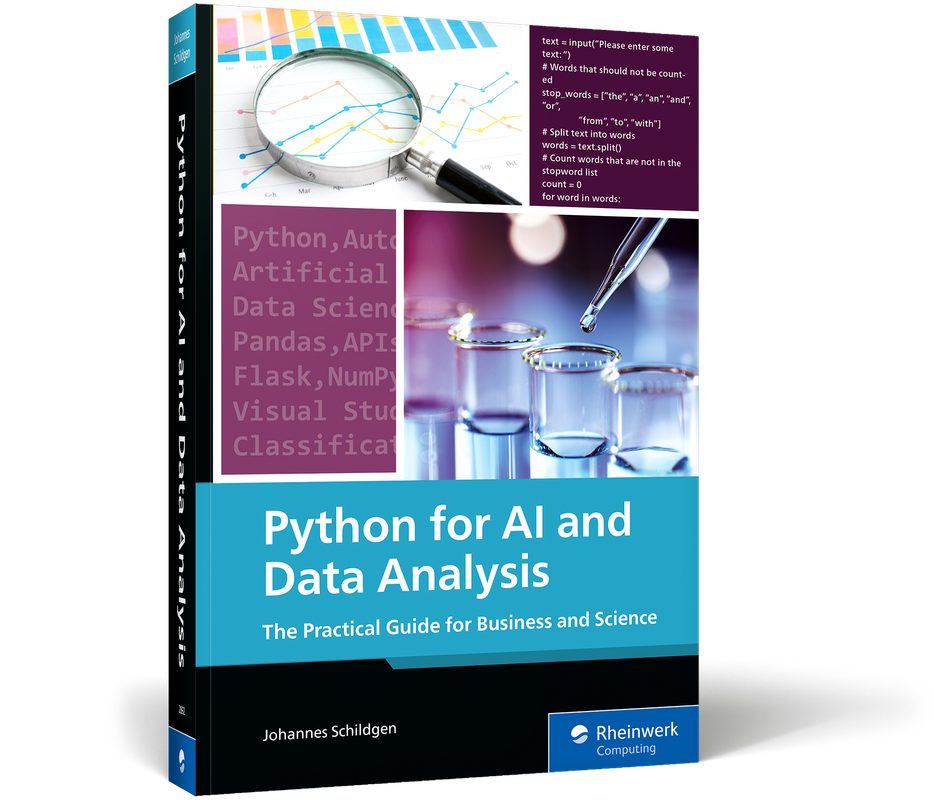
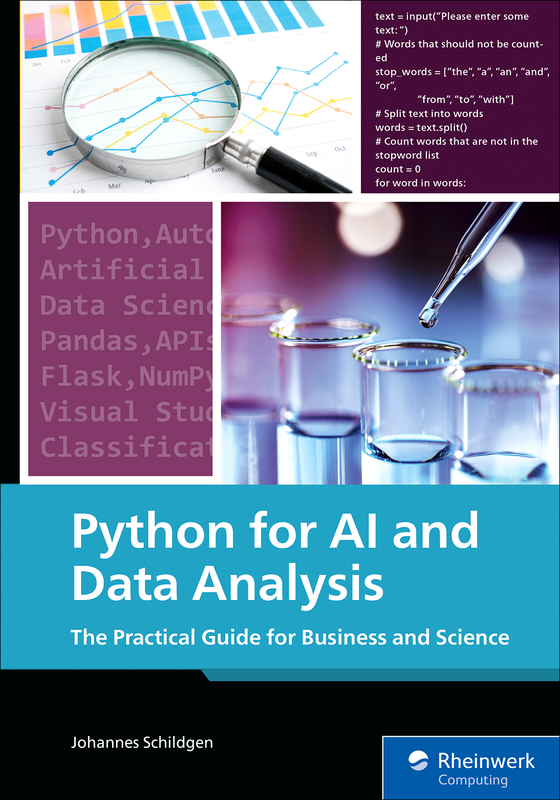

Python for AI and Data Analysis The Practical Guide for Business and Science
ca. € 49,95
Vorbestellbar
Lieferbar ab 08.12.2026
ca. € 49,95
Vorbestellbar
Verfügbar ab 08.12.2026
Rheinwerk Computing, ISBN 978-1-4932-2892-8
E-Book-Formate: PDF, EPUB, Online
Rheinwerk Computing, ISBN 978-1-4932-2893-5
Not a programmer by trade, but still want to use Python and AI in your day-to-day work? No problem! Learn how to use Python to analyze data, automate tasks, and work with models without getting bogged down by unnecessary busy work. You’ll learn about key tools like Visual Studio Code and Jupyter Notebooks and then jump straight into data analysis and visualization with NumPy, pandas, and Matplotlib. Hands-on examples will have you learning to clean, filter, and transform data, perform calculations, and create charts and interactive plots—right out of the gate!
- A practical guide to Python for AI and data projects
- Learn to analyze and visualize data with NumPy, pandas, and Matplotlib
- Use AI and machine learning for predictive modeling, text analysis, and image recognition
-
Code and Data Samples
This download includes data for your own programs and all the example projects from the book.
In this book, you'll learn about:
-
Data Analysis and Visualization
Get hands on with the Python data stack. Use NumPy and pandas to load, clean, filter, and transform data from CSV, Excel, JSON, and other formats. Then turn your results into compelling charts and interactive plots with Matplotlib.
-
Machine Learning and AI
Apply the tools professionals use! Work through classical machine learning methods—linear regression, decision trees, clustering, and more—before moving into natural language processing, sentiment analysis, image classification, and deep learning.
-
Automation and Real-World Applications
Take Python beyond analysis. Build lightweight web tools with Flask and Streamlit, scrape web pages, query databases, and automate recurring tasks—from PDF processing and document generation to scheduled data retrieval and email notifications.
Highlights include:
- Python fundamentals
- Data analysis
- Data visualization
- Machine learning
- Natural language processing
- Text and sentiment analysis
- Image recognition and classification
- APIs and web scraping
- Database access
- Task automation
Diese Bücher könnten Sie auch interessieren
-
Applied Machine Learning – Using Machine Learning to Solve Business Problems
440 Seiten, broschiert
E-Book-Formate: PDF, EPUB, Online€ 59,95
Sofort lieferbar
Buch | E-Book
-

Scripting – Automation with Bash, PowerShell, and Python
470 Seiten, broschiert
E-Book-Formate: PDF, EPUB, Online€ 49,95
Sofort lieferbar
Buch | E-Book
-
Programming Neural Networks with Python
457 Seiten, broschiert, in Farbe
E-Book-Formate: PDF, EPUB, Online€ 59,95
Sofort lieferbar
Buch | E-Book